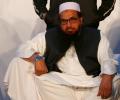
The National Investigation Agency (NIA) has filed a supplementary chargesheet naming Lashkar-e-Taiba (LeT) chief Hafiz Saeed as an accused in the Pahalgam terror attack, charging him with waging war against India and hatching a cross-border conspiracy.

Lakhvi's reported arrest, if confirmed, speaks of the intense pressure on Pakistan from the US to act against the Lashkar. India, the US and the rest of the international community should ensure that this is not a cosmetic step like similar steps in 2002 and that the LeT infrastructure in Pakistan is dismantled and those involved in the Mumbai terrorist strike against Indians, Israelis, Americans and others are brought to justice.

Lashkar-e-Taiba co-founder Amir Hamza was injured in a gun attack in Lahore. Unidentified gunmen targeted his vehicle, raising concerns about security and potential implications for the region.

The National Investigation Agency (NIA) filed a chargesheet against seven accused in the Pahalgam terror attack case, including Pakistan-based Lashkar-e-Taiba (LeT) and its proxy The Resistance Front (TRF).

The sources said that the terrorists were not expecting an action by the Indian Army and therefore were taken by surprise.

Lashkar-e-Taiba terrorist Umer Harris, also known as 'Khargosh', is believed to be in Saudi Arabia after escaping India using a forged passport. An investigation into the inter-state LeT terror module has exposed systemic loopholes and raised concerns about passport issuance processes.
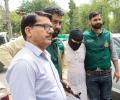
Delhi Police have arrested a suspected Lashkar-e-Taiba (LeT) handler, Shabir Ahmed Lone, in Delhi, uncovering a terror module with links to Pakistan's ISI. Lone is accused of running a network involved in pasting anti-national posters and planning terror activities across India.

The Dhurandhar movies will undoubtedly shape the minds of the audience much more than news reports, court investigations, books and documentaries. But it is worth remembering that Pakistan's irridentist claims against India's national security have succeeded due to strategic planning, diplomacy, and the unsung heroines and heroes across government agencies, not due to a single maverick leader, points out Shweta Desai.But it is worth to remember that Pakistan's irredentist claims against India's national security have succeeded due to strategic planning, diplomacy, and the unsung heroines and heroes across government agencies -- not a single maverick, points out Shweta Desai.

The missile was showcased at the recent Dubai Air Show and drew huge interest from potential buyer countries.

In a significant claim, Pakistani-American terrorist David Coleman Headley on Thursday said that Ishrat Jahan -- who was killed in an alleged fake encounter in 2004 in Gujarat --was actually a suicide bomber of Lashkar-e-Tayiba terror outfit.

The gunfight in the Cheyan Devsar area of the south Kashmir district broke out after security forces launched a cordon and search operation there following inputs about the presence of terrorists, a police official said.
In the wake of the confession by Canadian Pakistani Lashkar-e-Tayiba operative Tahawwur Hussain Rana, the Bhartiya Janata party asked the government to not hold any talks with Pakistan.
'It could be the Pakistan army's commercial interest, tactical or strategic interest or one of their leaders.' 'Even if you send a message that we have attempted to kill one of the Pakistani generals, that itself will serve the purpose.'
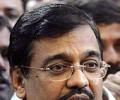
Eminent public prosecutor Ujjwal Nikam, who was instrumental in sending Ajmal Kasab, the lone surviving militant of 2008 Mumbai attack to the gallows, has termed David Headley's sentence as meagre in comparison to the brutality and heinousness of the crime.
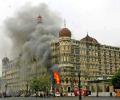
Lawyer Ujjwal Nikam says that while justice has been delivered to some victims of the 26/11 Mumbai terror attacks, their conspirators are still hiding in Pakistan. He criticizes Pakistan's handling of the trials of those arrested and calls for action against masterminds like Hafiz Saeed and Zakiur Rehman Lakhvi.
Finally, let us recognise that no one is going to fight our battles for us, that only we can safeguard our security and integrity through our own actions, and that any outside help, whether by a super power or the international community, can only be supplementary to our own efforts.
S M Mushrif says, in this brief interaction with rediff.com, that he would not allow the issue of Karkare's death to die down unless and until the matter is probed.
The man was carrying explosives in different form that would have killed un-suspecting school going children in the form of a book, or bottles and bicycle bells to be used as bombs were also recovered from him. "These deadly devices would explode on the spot and kill people," an army bomb expert said while explaining the method of operation. The explosives were also used in tiffin boxes and dolls, to target children.
Rehana herself has been convicted for sheltering Ashfaq.
The trial of Abu Jundal, accused in the 26/11 Mumbai terror attacks, is set to resume after the Bombay High Court overturned a lower court order requiring authorities to hand over confidential documents to the accused.
The prosecution in the Red Fort shootout case on Friday said there was strong evidence that Shahanshah Alam had secured a fake ration card and a driving license for alleged Lashkar-e-Toiba terrorist and main suspect Ashfaq Ahmed.
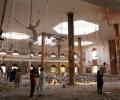
In 2025, India launched Operation Sindoor, a multi-domain combat mission against Pakistan in response to cross-border terrorism. The operation involved precision strikes, military retaliation, and diplomatic measures, marking a significant shift in India's security policy.
'I don't see any relationship between them and ex-army or ex-ISI as has been happening in the past,' says strategic analyst Shuja Nawaz, who is convinced the Pakistan army and its intelligence wing, the Inter-Services Intelligence, are not complicit in the Mumbai terror attacks.
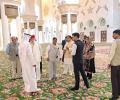
India succeeded in busting the Pakistani narrative on Operation Sindoor, particularly among the Organisation of Islamic Conference (OIC) member nations, where Islamabad sought succour after carrying out terror activities across the border, Shiv Sena leader Shrikant Shinde said.
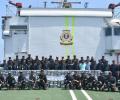
The National Investigation Agency (NIA) has charge-sheeted eight more individuals in connection with a 2020 transnational narco-terror network case involving the smuggling of drugs from Pakistan to Gujarat, with the aim of financing the Lashkar-e-Taiba (LeT) terror group.
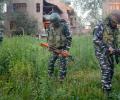
The officer said the terrorist's name surfaced during the investigation of an arms dropping case through drone from Pakistan on February 24 in Arnia sector.

The Border Security Force (BSF) launched "Operation Sindoor" in retaliation to unprovoked firing and shelling by Pakistani Rangers along the International Border (IB) in Jammu. BSF troops destroyed three terrorist launch pads and targeted 76 Pakistani border outposts and 42 forward defence locations. The BSF action came after Pakistan launched heavy firing and shelling on 60 Indian posts and 49 forward positions, reportedly providing cover for an attempted infiltration by 40-50 terrorists.
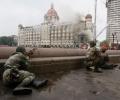
The Maharashtra government informed the Bombay High Court that Faheem Ansari, acquitted in the 26/11 terror attack case, was denied a police clearance certificate due to ongoing suspicion of being a member of a banned terror organization. Ansari sought the certificate to operate an autorickshaw.
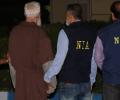
According to the chargesheet, Rana played a crucial role in supporting terrorist David Coleman Headley, a Pakistani-American operative linked to Lashkar-e-Taiba, by facilitating his reconnaissance missions across Mumbai.

The Air Chief revealed information about India's damage to Pakistan's defence capabilities while addressing an event at the Hal Management Academy in Bengaluru on Saturday.
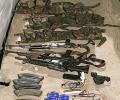
Security agencies have gathered evidence, including Pakistani government documents and biometric data, confirming that the terrorists involved in the Pahalgam attack were Pakistani nationals.
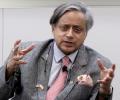
"I'm very glad you raised this, Ishaan. I didn't plant it. I promise you. This guy does this to his dad," Tharoor replied amid laughter from the audience.
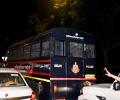
Tahawwur Hussain Rana, a key figure in the 2008 Mumbai terror attacks, has been extradited from the US to India and produced before a Delhi court. Rana, a close associate of David Coleman Headley, was brought to India after the US Supreme Court dismissed his review plea against extradition. The National Investigation Agency (NIA) has sought 20 days of custody to interrogate Rana, citing clinching evidence, including emails. The agency believes that Rana's interrogation is critical to understanding the larger conspiracy behind the attacks and his role in planning them.

US President Donald Trump claimed that "five jets were shot down" during the conflict between India and Pakistan in May and repeated his assertion that the fighting ended following his intervention. India has maintained that the two sides halted their military actions following direct talks between their militaries without any mediation by the US.
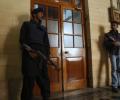
An armed guard of Qatal was also killed in the attack that took place on Saturday night.

External Affairs Minister S Jaishankar discusses India's approach to cross-border terrorism following the Pahalgam attack, emphasizing a firm response and no compromise on nuclear blackmail.
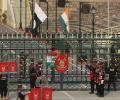
In the India-Pakistan situations, off-ramps have come either through foreign mediation (after months of kinetic warfare over Kargil, and a long stand-off with Op Parakram) or when a situation made it possible for both sides to claim a win, explains Shekhar Gupta.

'There's a lot of sense in what Prime Minister Modi did, but the Indian government has to be really prepared for a really sharp escalation spiral.'
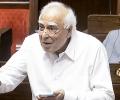
Rajya Sabha MP Kapil Sibal has congratulated both the previous UPA government and the current dispensation for the extradition of Tahawwur Hussain Rana, the mastermind behind the 2008 Mumbai attacks. Sibal expressed confidence that the extradition will shed light on the involvement of individuals within Pakistan's establishment in the attacks. Rana is being questioned by the National Investigation Agency (NIA) to uncover the full extent of the conspiracy behind the deadly 2008 terror strikes. Sibal highlighted the efforts of the UPA government in establishing the NIA and pursuing Rana's extradition, and also acknowledged the current government's success in bringing him back to India. The interrogation is expected to focus on Rana's potential ties to the Lashkar-e-Taiba (LeT) and his role in the Mumbai attacks.
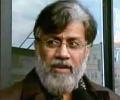
Tahawwur Hussain Rana, a Canadian national convicted in the United States for his role in the 2008 Mumbai terror attacks, has been extradited to India. Rana, a close associate of Pakistani-American terrorist David Coleman Headley, was involved in the conspiracy from 2005 onwards and assisted Headley in obtaining a visa for India. He is the third person to be sent on trial in India for the 26/11 attacks after Ajmal Kasab and Zabiuddin Ansari alias Abu Jundal. Rana's extradition comes after US President Donald Trump approved the request.
